







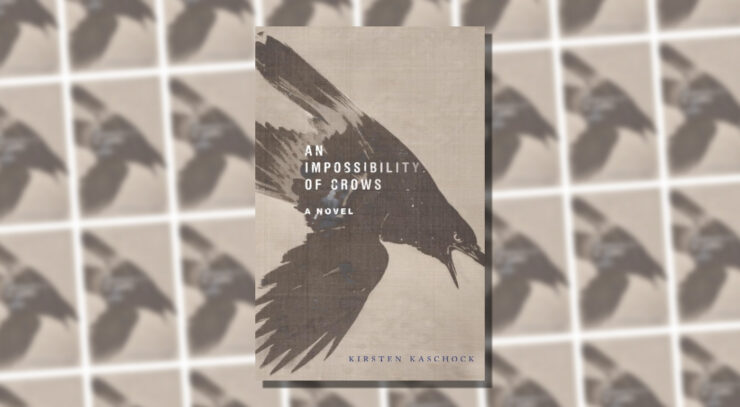
I started reading Kirsten Kaschock’s An Impossibility of Crows in a state of uncertainty. The book is published by a university press; the cover copy describes a woman trying to breed a crow large enough to carry her daughter. I had questions: A real crow, or a metaphorical crow? Are we in avian Frankenstein territory, or is the crow an imagined manifestation of grief and/or trauma? The latter can be powerful, but I was more intrigued by the former.
The crow is real. Just to be clear. And there is a lot of grief and trauma.
Agnes Krahn is not in a good state when she returns to her childhood home in rural Pennsylvania. At the book’s start, her husband, Bruce, has already left, taking their daughter Mina with him. He is—fairly understandably—upset about how much time Agnes has been spending in the barn, breeding crows. The latest crow, who is also the last crow in his line, is a behemoth named Solo. Solo speaks, sort of, in short sentences. Solo is a different creature entirely from the crows in the trees behind the house. For one thing, there are many of them. There is just one Solo.
Kaschock is a poet as well as a novelist, and she tells Agnes’s story in tightly wound sentences, occasionally interspersed with Agnes’s mother’s journal and Bruce’s poetry. (Her sly little comments about Bruce’s literary life, with his occasional escapes to Brooklyn, are tartly funny.) The book takes the form of Agnes’s journal, as she documents the move to her childhood home, the breeding of her crows, the state of her dissolving marriage, her fears and guilt about her daughter, her memories of a strained childhood, and the shape of the land and people around her. Agnes—who was once a chemist, and worked in a poultry factory—is as sharply observant about her world as she is about her own failings. Blood seeps through the pages, from the doomed small creatures she feeds to Solo to the nearby fields of Gettysburg, rich with the memory of blood. A sense of threat hangs over all: People disappear from towns like hers for all kinds of reasons.
Buy the Book

An Impossibility of Crows
Agnes wants to create a crow big enough to carry her daughter, who was born with a disability that is not specified for much of the book, and the details of which should be left for a reader to discover. It’s not that there are spoilers, as such, in this psychologically rich story, but that the uncovering, the slow peeling-back of history and legacy, are what gives the story such power. As a scientist, documenting her experiment, Agnes is forthright, factual, almost dry, but the past she revisits is fraught, dangerous, unstable—and prone to repeating itself in new shapes and forms. Kaschock is unsparing and sharp in exploring the way families hurt each other, intentionally or not: Does it make a difference, ultimately, if one person causes harm to a child accidentally, and one does it with intention? Can you make up for it either way? “Listen to me, my brooding one,” Agnes’s mother says to her, when she’s a small child. “You cannot give, or take, anything back. Not a single thing that you have said or done—not a thing you ask or are asked to carry.”
As alarming as Solo is, he’s a beautifully imagined creature. You, or at least I, wanted him to escape and live his own wild life, except for the little fact of all the damage he might do. But who doesn’t do damage? Who moves through life causing no harm? If it’s in his nature to fly away, to potentially damage things in order to survive, what’s in human nature?
Kaschock walks a powerful line with Agnes, whose dream is clearly impossible—where would Solo carry Mina, even if he consented to do such a thing, even if Mina wanted it?—and yet alluring, in the way creating the impossible is always alluring. Wry and practical to a fault, Agnes responds to a rapidly escalating situation—Solo escapes; a little girl goes missing; Agnes’s somewhat estranged, deeply religious sister gets involved—with pragmatism and stubbornness, with clarity and fear. The story moves between her childhood and her adult life, swirling and eddying in the places where pain lingers. Thinking about how this story is told, I find myself thinking in tight little sentences like Agnes writes, caught up in the voice Kaschock has created for her character. She knows her failures, this woman, but she doesn’t always react to them, work on them, the way a person might want her to. She is magnificently ambivalent about some things, alarmingly focused on others.
The plot is simple: Agnes creates Solo; in his wake comes chaos. But the complexity of how Agnes became Agnes, how she responds in a crisis, how she loves in a way that doesn’t always look like love—these layers make for an intense reading experience. (There is a viscerally upsetting climactic sequence involving bones. This image will never leave my mind.) I felt a little haunted by this book, like it had presence, like it was waiting for me to finish it. Between the trees and the fields and the barn and the birds, it’s vividly drawn, beautiful in a bleak way. Kaschock never looks away, never flinches, and never resorts to simple explanations for the things people do to one another, as often as not out of something that means to be love. The crow and the bleakness, the fields and disconnect among humans, between humans and the rest of the world—it made me think a bit of Anne de Marcken’s It Lasts Forever and Then It’s Over. They’re very different books, but unforgettable crows fly between them.
I also thought a lot about genre while reading this book: about how, with a different cover—glossy black, a different font, a more vivid sense of menace—it might call to a different reader. Is it a horror novel? What makes a horror novel as opposed to a novel in which things happen which are horrifying? I wanted to press it on all the horror readers I know and ask them: Where does it fit in your taxonomy? Literary horror, psychological horror, small-town Gothic?
I was out of my comfort zone, is what I’m saying. But on the other hand, this novel slides between genres elegantly, and that in-between land is exactly where I love to read. It’s Kashock’s second novel, but sixth book of poetry, and Agnes’s short sentences, briskly powerful descriptions, they are poetry. The physicality of Solo and his capabilities, and the whispering of the crows in the trees, and the ways people die in small towns: These things are haunting, even—or especially—when they’re real. The Impossibility of Crows is beautifully written, eerie, grounded, honest, and striking. The kind of striking that leaves a bruise.
An Impossibility of Crows is published by University of Massachusetts Press.
